
Secure AI Deployment Models
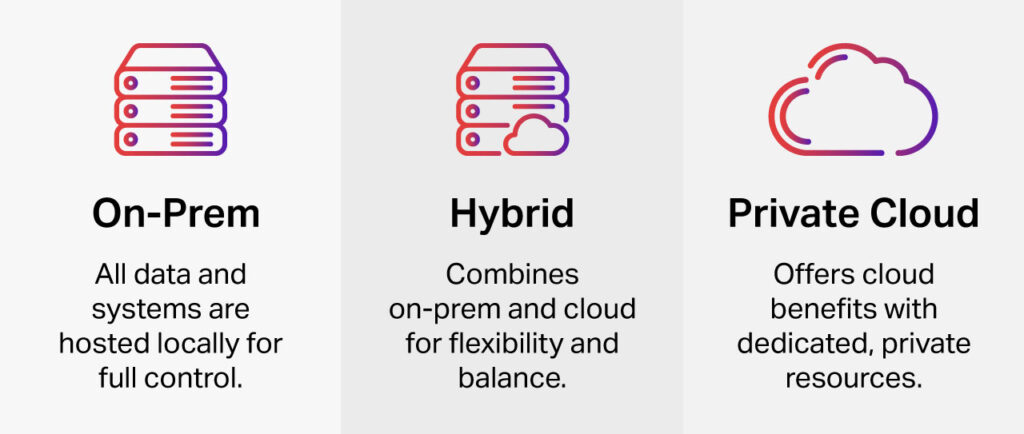
Choosing the right deployment model is one of the most consequential security decisions an organization makes when adopting AI. The deployment architecture determines where data flows, who can access model outputs, and how effectively the organization can enforce its security and compliance requirements. There is no single correct approach — the right model depends on data sensitivity, regulatory obligations, latency requirements, and available infrastructure.
Public cloud AI deployments offer the fastest path to capability but introduce the greatest data exposure risk. When queries are sent to third-party hosted models, organizations lose direct control over how that data is processed, logged, or retained. This model is generally appropriate only for non-sensitive workloads where data residency and confidentiality requirements are minimal. Organizations using public cloud AI should review provider data handling agreements carefully and establish clear policies on what categories of information employees are permitted to submit.
Private cloud and on-premises deployments address the core concern of data sovereignty by keeping all inference activity within the organization’s own infrastructure. Models are hosted internally, meaning sensitive prompts and outputs never traverse external networks. This approach is particularly relevant for organizations subject to strict regulatory frameworks — such as those operating under Qatar’s NCSA requirements or handling classified data — where data residency is non-negotiable. The trade-off is higher operational overhead, including model hosting, hardware provisioning, and ongoing maintenance.
Hybrid deployment models allow organizations to route workloads based on sensitivity classification. Non-sensitive tasks can leverage public cloud AI for speed and cost efficiency, while sensitive or regulated workloads are directed to private infrastructure. This requires a well-defined data classification policy and routing logic that enforces boundaries consistently, but it gives organizations flexibility without compromising on security where it matters most.
Air-gapped deployments represent the most restrictive option, isolating AI systems entirely from external networks. These are appropriate for environments handling highly classified information where even private cloud connectivity introduces unacceptable risk. Air-gapped AI deployments require significant investment in local compute infrastructure and limit the ability to update models or access external knowledge, but they provide the strongest possible data containment guarantees.
Across all deployment models, common security controls apply: access should be governed through role-based permissions, all interactions should be audit-logged, model endpoints should be protected against unauthorized access, and usage policies should be clearly communicated to users. The deployment model sets the perimeter — but layered controls within that perimeter determine whether the organization’s AI posture is truly secure.