
Managing Change During AI Transformation
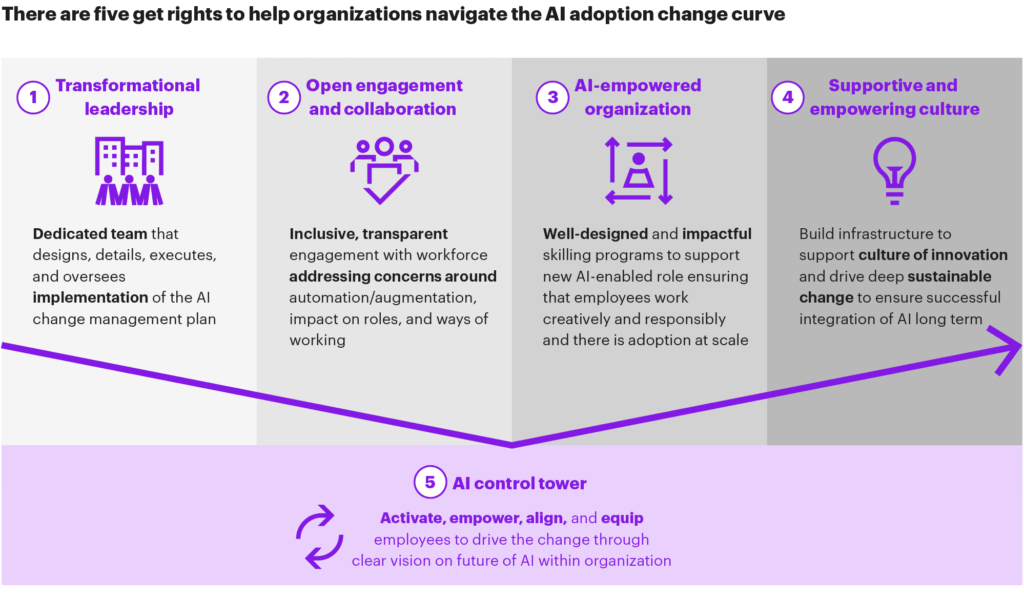
AI transformation is, at its core, a human challenge as much as a technical one. Organizations that treat AI adoption primarily as an infrastructure project consistently underestimate the organizational disruption it creates. Workflows change, roles evolve, and employees are asked to trust systems they may not fully understand. Managing this change effectively is what separates AI initiatives that deliver sustained value from those that generate resistance, workarounds, and eventual abandonment.
Understanding the sources of resistance is where change management must begin. Employees resist AI adoption for a variety of reasons — fear of job displacement, distrust of automated outputs, concern about being evaluated or surveilled by AI systems, or simply the friction of learning new ways of working. These concerns are legitimate and should be treated as such. Leaders and change managers who dismiss resistance as irrational or obstructionist tend to drive it underground rather than resolve it, where it continues to undermine adoption in less visible ways.
Communication strategy is foundational. Employees need to hear clearly and consistently what AI is being introduced, why the organization is adopting it, how it will affect their specific roles, and what protections are in place around their work and data. Vague messaging — or worse, silence followed by sudden deployment — breeds anxiety and speculation. The most effective communication is specific, honest about trade-offs, and delivered through managers who are themselves informed and confident about the change.
Training and capability building must be treated as a serious investment, not a checkbox. Effective AI training goes beyond teaching employees how to use a tool — it builds judgment about when to rely on AI outputs, when to question them, and how to recognize when a model is producing unreliable results. This is particularly important in professional contexts where AI-assisted decisions carry real consequences. Training should be role-specific, practical, and reinforced over time rather than delivered as a single onboarding session.
Phased rollout and pilot programs reduce risk and build organizational confidence. Introducing AI capabilities to a subset of teams first allows the organization to identify integration problems, gather honest feedback, and refine both the technology and the change process before scaling. Employees who participate in pilots often become internal advocates — a far more credible source of peer influence than top-down mandates.
Measuring adoption and outcomes closes the feedback loop. Organizations should track not just whether AI tools are being used, but how they are being used, whether usage patterns align with policy, and whether the intended productivity or quality improvements are materializing. Where adoption is low or outcomes are disappointing, the response should be diagnostic rather than punitive — understanding the barriers and addressing them is more productive than pressure campaigns.
Finally, sustaining the change over time requires ongoing attention. AI transformation is not a project with a defined end date — it is a continuous process of integrating new capabilities, retiring outdated ones, and helping the workforce adapt as the technology and the business environment evolve. Organizations that build durable change management capacity, rather than relying on one-time transformation initiatives, are better positioned to keep pace with that ongoing evolution.