
Long-Term Strategy for Enterprise AI
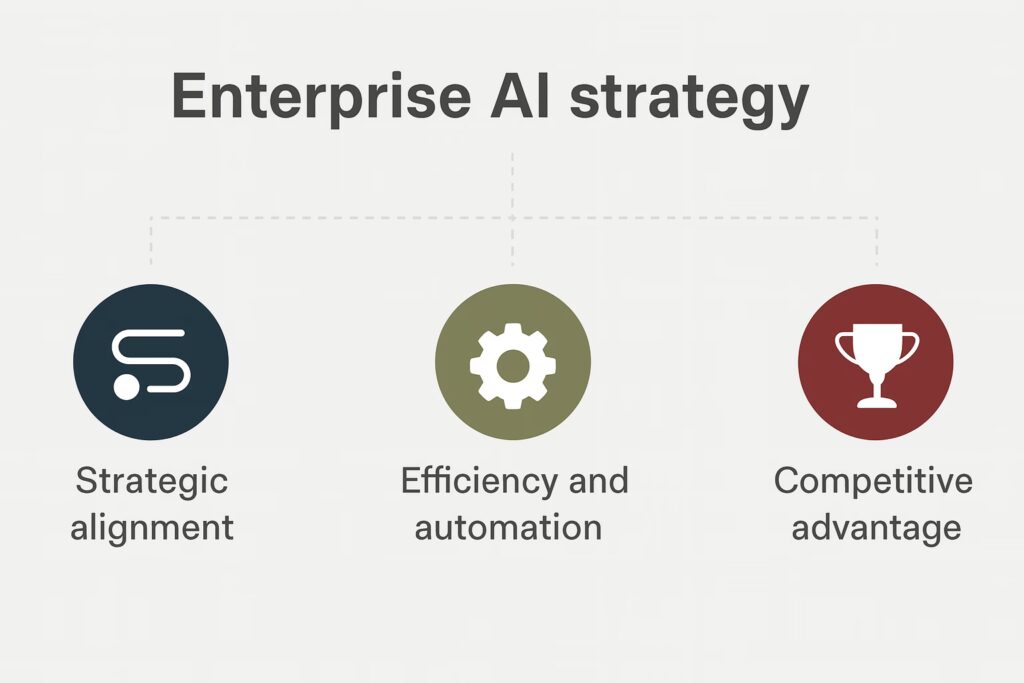
Most enterprise AI activity today is tactical. Organizations identify a promising use case, deploy a tool, measure near-term productivity gains, and move to the next initiative. This approach produces real value, but it does not constitute a strategy. A long-term AI strategy is something different: a deliberate plan for how the organization will build, sustain, and evolve AI capabilities over years — not quarters — in ways that compound into durable competitive advantage rather than a collection of disconnected point solutions.
The distinction between AI projects and AI capability is where long-term strategy begins. A project has a defined scope, a delivery date, and a budget. A capability is an organizational asset that persists, improves, and generates value across multiple applications over time. Organizations focused exclusively on projects accumulate tools without building the underlying infrastructure — data architecture, governance frameworks, talent, institutional knowledge — that makes each successive AI initiative faster, safer, and more effective than the last. Long-term strategy is fundamentally about building capability, with projects as the means rather than the end.
Data strategy is inseparable from AI strategy. The quality, accessibility, and governance of an organization’s data determines the ceiling on what its AI systems can achieve. Organizations that have invested in clean, well-structured, appropriately governed data assets find that AI capabilities can be developed and deployed far more rapidly and reliably than those operating with fragmented, inconsistent, or poorly documented data. Long-term AI strategy must therefore include a serious commitment to data infrastructure — not as a prerequisite that will eventually be completed, but as an ongoing discipline that evolves alongside AI capabilities themselves.
Talent and organizational design are strategic variables that receive insufficient attention in most AI planning discussions. The long-term AI capability of an organization is constrained by the people it can attract, develop, and retain — data scientists, ML engineers, AI governance specialists, and equally importantly, business leaders who understand AI well enough to identify high-value applications and oversee them effectively. Organizations should think carefully about the balance between building internal talent and leveraging external expertise, recognizing that certain capabilities — particularly those tied to proprietary data and institutional knowledge — are more strategically valuable when developed internally.
Governance infrastructure must scale with AI ambition. Organizations that begin with a handful of AI pilots can manage governance through manual processes and informal oversight. As the AI portfolio grows — more models, more use cases, more data flows, more regulatory exposure — that approach breaks down. Long-term strategy requires building governance infrastructure that scales: centralized model registries, automated compliance monitoring, standardized risk assessment processes, and clear escalation paths that do not create bottlenecks as the number of AI systems in production grows. Organizations that invest in scalable governance early avoid the painful and expensive process of retrofitting it onto a large, ungoverned AI portfolio later.
Vendor and technology dependencies require active management over a long time horizon. The AI technology landscape is changing rapidly, and commitments made today — to specific platforms, model providers, or architectural approaches — will constrain options in ways that are difficult to fully anticipate. Long-term strategy should favor architectural flexibility where possible, avoid deep lock-in to single vendors without deliberate consideration of the trade-offs, and include regular reassessment of whether the technology choices underpinning the AI portfolio remain the best available options or have been superseded by developments that warrant migration.
Regulatory anticipation is a strategic capability in its own right. AI regulation is evolving across jurisdictions, and organizations that monitor regulatory developments and build compliance considerations into their AI architecture proactively will face far lower adaptation costs than those that treat regulation as an external constraint to be addressed only when it becomes mandatory. This is particularly relevant for organizations operating across multiple jurisdictions with divergent regulatory approaches, where the cost of maintaining separate compliance postures for each market can be substantially reduced through thoughtful architectural decisions made early.
Ultimately, long-term enterprise AI strategy is an exercise in institutional building. The organizations that will derive the most sustained value from AI over the next decade are not necessarily those with the largest technology budgets or the most aggressive deployment timelines — they are those that build the data foundations, governance structures, talent pipelines, and organizational cultures that allow AI capability to compound over time. That kind of institution does not emerge from a series of tactical projects. It is the product of deliberate, sustained strategic commitment.