
Measuring ROI in Enterprise AI
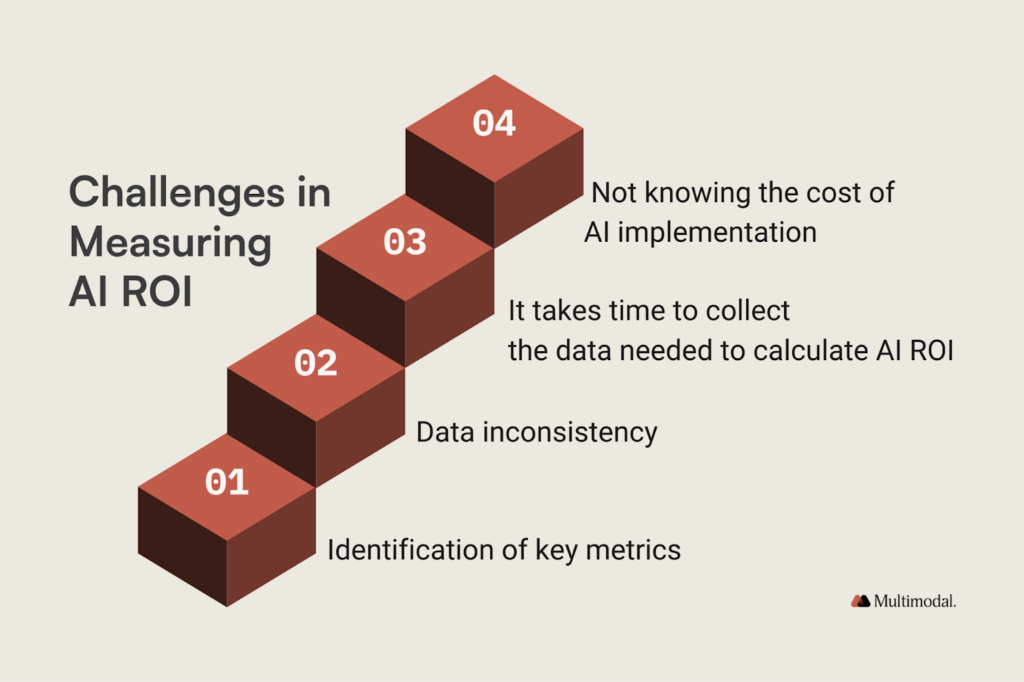
Return on investment in enterprise AI is genuinely difficult to measure, and organizations that pretend otherwise tend to produce metrics that look compelling in presentations but provide little useful information for decision-making. The difficulty is not a reason to avoid measurement — it is a reason to approach it carefully, with clear thinking about what is actually being measured, what the counterfactual would have been, and what time horizon is appropriate for the type of value being created. Organizations that develop rigorous AI ROI frameworks make better investment decisions, retire underperforming initiatives faster, and build the institutional credibility needed to sustain AI investment over time.
Defining value categories before deployment is the prerequisite for meaningful measurement. AI initiatives create value through several distinct mechanisms that require different measurement approaches. Efficiency gains — reduced time to complete tasks, lower error rates, decreased headcount requirements for routine work — are the most directly quantifiable and often the easiest to measure. Quality improvements — more consistent outputs, better decision accuracy, higher customer satisfaction — are real but require more careful baseline establishment and attribution analysis. Strategic value — competitive differentiation, new capabilities, faster innovation cycles — is the hardest to quantify but often the most significant over longer time horizons. Organizations should be explicit about which value category a given AI initiative is primarily targeting, because the measurement approach follows from that categorization.
Establishing baselines before implementation is a step that many organizations skip and consistently regret. Without a documented understanding of current performance — time spent on a task, error rate in a process, cost per unit of output — there is no credible basis for claiming that AI has improved anything. Baselines should be established during the planning phase, before AI systems are deployed, and should be specific enough to be measurable rather than general enough to be unfalsifiable. An organization that knows it takes an average of four hours to complete a specific analysis, with a measured error rate and a known cost, is in a position to measure whether AI assistance changes those numbers. One that did not document the baseline before deployment is left with anecdote and estimation.
Attribution is the central methodological challenge in AI ROI measurement. AI systems rarely operate in isolation — they are introduced alongside other process changes, organizational restructuring, and market shifts that independently affect the outcomes being measured. Attributing observed improvements entirely to AI will typically overstate the technology’s contribution, while ignoring confounding factors produces measurements that do not withstand scrutiny. Organizations should design measurement approaches that account for this complexity — using control groups where feasible, being transparent about the limitations of attribution analysis, and presenting ranges rather than point estimates when uncertainty is high.
Total cost of ownership must be fully accounted for on the investment side of the ROI calculation. The licensing or infrastructure cost of an AI system is usually the most visible line item but rarely the largest one. Implementation costs, integration work, training and change management, ongoing model maintenance, governance and compliance overhead, and the cost of security controls all belong in the calculation. Organizations that measure ROI against only the direct technology cost will systematically overstate returns and make capital allocation decisions on a distorted basis.
Time horizons should be matched to value types. Efficiency gains from AI often materialize quickly and can be measured within months of deployment. Strategic value, competitive positioning, and capability development typically require years to fully manifest. Organizations that apply short-term ROI measurement frameworks to long-term strategic AI investments will undervalue those investments and underfund them. Finance and business leadership should agree on appropriate time horizons for each category of AI initiative before measurement begins, rather than defaulting to annual ROI calculations for all AI spending regardless of its nature.
Communicating ROI findings honestly — including initiatives that have underperformed expectations — is what makes measurement valuable rather than merely reassuring. Organizations where AI ROI reporting is implicitly understood to be a justification exercise rather than a genuine assessment will not surface the information needed to improve. Leaders who respond to honest underperformance data with analysis and course correction rather than pressure to revise the numbers create the conditions under which AI investment decisions genuinely improve over time.