
AI Transparency and Accountability
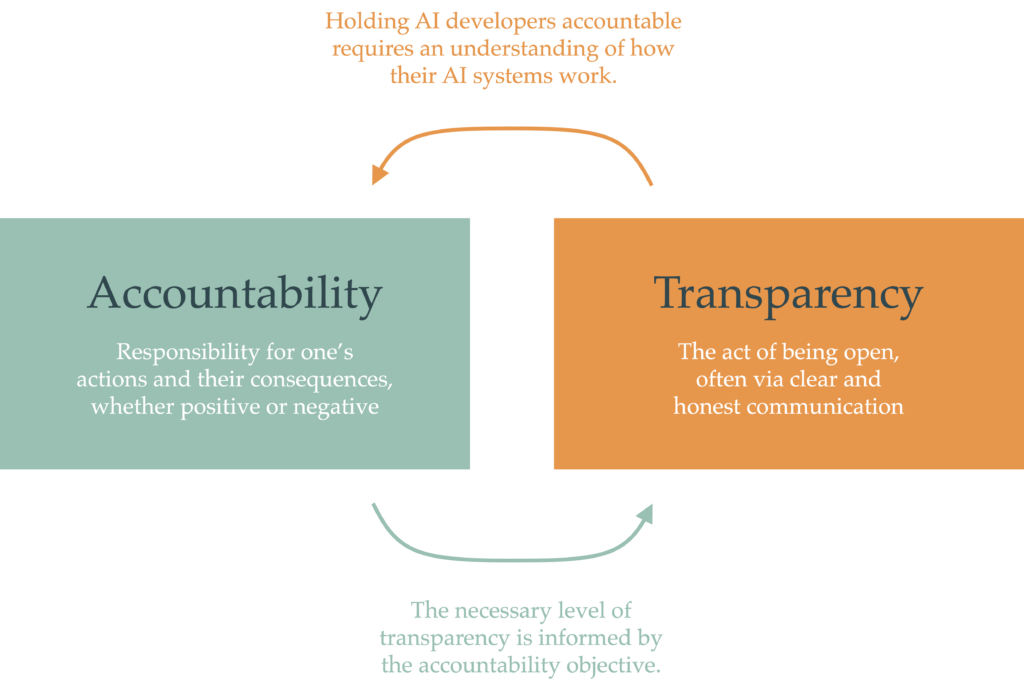
Transparency and accountability are the foundations upon which trustworthy AI is built. Without transparency, organizations cannot understand what their AI systems are actually doing — which makes meaningful oversight impossible. Without accountability, there is no clear answer to the question of who is responsible when an AI system causes harm — which makes remediation inconsistent and governance largely performative. Together, these principles determine whether an organization’s AI posture is genuinely sound or merely compliant on paper.
Transparency in AI operates at multiple levels, and organizations must be deliberate about which levels they are addressing. At the system level, transparency means maintaining clear documentation of what each AI model does, what data it was trained on, what its known limitations are, and what decisions or processes it influences. At the operational level, it means logging how models are used, by whom, and with what inputs and outputs. At the stakeholder level, it means being able to communicate honestly — to employees, customers, regulators, and partners — about where and how AI is being used and what safeguards are in place. Each level requires different mechanisms, but all three are necessary for a complete transparency posture.
Explainability is a specific and often technically demanding dimension of transparency. For many AI applications, particularly those using large language models or complex machine learning systems, the internal reasoning that produces a given output is not directly interpretable. This creates a genuine challenge in regulated domains where decision-makers must be able to explain or justify outcomes — in credit decisions, hiring processes, medical recommendations, or legal contexts. Organizations should assess explainability requirements for each AI use case and select or design systems accordingly. Where full explainability is not technically achievable, compensating controls — such as human review requirements, output documentation, and appeal mechanisms — should be implemented to preserve accountability even when the model’s reasoning cannot be fully articulated.
Audit trails are the operational infrastructure of accountability. Every consequential AI interaction — particularly those that inform decisions affecting individuals or organizational outcomes — should be logged in sufficient detail to support post-hoc review. This means capturing not just the final output, but the inputs provided, the model version used, the timestamp, and the identity of the user or system that initiated the interaction. Without this record, investigations into AI-related incidents are hampered, regulatory inquiries cannot be answered satisfactorily, and the organization has no reliable basis for understanding how its AI systems are actually being used in practice.
Designated accountability resolves the diffusion of responsibility that otherwise characterizes AI governance failures. When an AI system produces a harmful outcome, the question of who is accountable should have a clear, pre-defined answer — not one that is negotiated after the fact between technology teams, business units, and legal functions. Organizations should assign explicit ownership for each AI system in production, covering both technical performance and the downstream consequences of the system’s outputs. This ownership should be documented, communicated, and reflected in performance expectations rather than existing only as an informal understanding.
External transparency obligations are growing as regulatory frameworks around AI mature. Organizations in regulated industries or jurisdictions with AI-specific legislation may be required to disclose their use of automated decision-making, provide individuals with the ability to contest AI-generated decisions, or submit to audits of their AI systems by regulators or third parties. Staying ahead of these obligations — rather than treating them as burdens to be managed reactively — requires organizations to build transparency and accountability into their AI systems from the outset rather than retrofitting them later at considerably greater cost and disruption.
Ultimately, transparency and accountability serve not just compliance objectives but organizational resilience. Organizations that know what their AI systems are doing, who is responsible for them, and how they are performing are organizations that can identify problems early, correct them effectively, and maintain the confidence of the people who depend on them.